We've all had those moments. You're driving home from work, sitting alone after everyone has gone to bed, or scrolling through your phone on a Sunday evening, and a thought quietly creeps in: How did life become so… routine?
It's not that everything is falling apart. You may have a stable job, a loving family, and responsibilities you've invested so much of yourself in. But somewhere along the way:
- Your health took a backseat.
- Your finances became reactive instead of intentional.
- Your relationships started running on autopilot.
- Your personal goals slowly moved to the bottom of the list.
Life doesn't usually unravel overnight. It drifts. The good news? It can drift in the right direction too.
“You don't need to quit your job, move to another city, or wake up at 5 AM every day to reinvent yourself.”
More often than not, lasting change comes from small, consistent improvements in the areas of life that matter most. Think of the next 100 days as a chance to pause, step back, and intentionally rebuild the important areas of your life.
In this blog, we'll walk through a practical roadmap to help you become a little better, day by day.
Why We Keep Starting Over (And Why It Doesn't Work)
If you've ever started a new routine with great enthusiasm, only to give up a few weeks later, you're not alone. The problem usually isn't a lack of motivation. It's trying to change too much, too soon. Here are some of the things we try to fix all at once:
- A new workout routine
- A strict diet
- Daily meditation
- Reading every morning
- Saving more money
- Learning a new skill
- Spending more time with family
On their own, these are all solid goals. Together, they become too much to manage. Research on behaviour change consistently shows that starting small, staying consistent and building on small wins works better than chasing perfection. Change also means stepping outside what feels familiar – here's how to get out of your comfort zone in 10 simple steps.
Why 100 Days? Why Not 30 Days, or a Year?
Because 100 days is long enough to get past the initial thrill of starting something new.
A well-known study from University College London found that new habits took an average of 66 days to become automatic, and anywhere from 18 to 254 days depending on the person and the habit. That's why 30 days often isn't enough, while 100 days gives most habits time to settle in.
It also gives you time to form new routines, recover when things go wrong, adjust your approach, and see progress that actually means something. It's like planting a tree: nothing much seems to happen in the first few weeks, but if you keep watering it, the roots grow long before you see a branch. Your habits grow the same way.
Step One: Check In With Yourself
Before fixing your life, understand where you are today. Take a notebook and rate yourself from 1 to 10 in each of these seven areas, using the question beside it as your guide.
| Area | Ask yourself | Your score (1–10) |
|---|---|---|
| Financial | Do I feel in control of my money, or is money constantly controlling my decisions? | |
| Physical | Do I have enough energy to enjoy my life? | |
| Mental | How often do stress or negative thoughts dictate my day? | |
| Family | Do the people I love get the best version of me, or whatever energy is left after work? | |
| Social | Am I investing in meaningful relationships, or just staying busy? | |
| Career | Am I growing professionally, or simply maintaining my current position? | |
| Spiritual | Do I know what truly matters to me beyond achievements? |
Don't judge your answers. They're simply your starting point.
Your 100-Day Reset Guide: The Four Phases
The best way to approach your reset is in four phases: self-awareness, stability, better habits and lasting change. Don't try to work on all seven areas at once. In each phase, pick one or two areas – usually the ones with your lowest scores – and apply that phase's focus to them.
| Phase | Focus | What it looks like |
|---|---|---|
| Days 1–20 | Observe | Track spending, sleep, energy and how you spend your time |
| Days 21–50 | Fix the basics | A realistic budget, better sleep, regular movement, one family ritual |
| Days 51–80 | Build | A new skill, consistent reading, reconnecting with people |
| Days 81–100 | Keep | Decide which habits stay for good |
Days 1–20: Get to Know Your Current Habits
Don't rush to change everything. Instead:
- Observe your routines.
- Track your spending.
- Notice your sleep.
- Pay attention to your conversations.
- Write down what drains your energy and what gives you energy.
Awareness always comes before improvement.
Days 21–50: Get the Basics Right
Now start strengthening your foundation:
- Prioritise sleep.
- Move your body regularly.
- Review your finances.
- Reduce unnecessary commitments.
- Spend more intentional time with your family.
Small changes here create a ripple effect for everything else.
Days 51–80: Create New Habits
Once your foundation feels stronger, start putting energy into growth:
- Learn a new skill.
- Work on your communication.
- Develop healthier financial habits.
- Read consistently.
- Challenge limiting beliefs.
Growth feels much easier when your basics are already in place.
Days 81–100: Think Beyond the Reset
This last phase isn't about doing more. It's about making your progress sustainable. Ask yourself: “Which habits deserve a permanent place in my life?”
That's when a reset becomes a lifestyle.
Reset Every Area of Your Life
If you want to reset your life, don't start by adding more to your plate. Start by clearing it. For the next 100 days, reduce distractions, step back from unnecessary commitments, and give your energy to what truly matters. Here's how to approach each area – from your health and mindset to your relationships, career, finances and sense of purpose.
1. Finances: Understand Your Money Habits
Financial stress affects almost every area of life – your relationships, career decisions, confidence and even your health. Instead of obsessing over earning more right away, spend the first month understanding your current money habits:
- Review your expenses.
- Identify your emotional spending triggers.
- Create a realistic monthly plan, not an ideal one.
If money worries are weighing on you, these practical ways to manage financial stress are a good place to start.
For many people, fixing their relationship with money starts long before a bigger paycheck – it starts with looking at money differently. That's the idea behind Success Gyan's Millionaire Mind Intensive, a three-day program that helps people question the money habits they've carried for years.
This week, ask yourself: “Does my spending reflect my priorities?”
2. Physical Health: Protect Your Energy
As responsibilities grow, energy becomes more valuable than time. Without it, everything else becomes harder. You don't need an extreme fitness challenge. Focus on the fundamentals:
- Walk daily.
- Do strength training two or three times a week.
- Prioritise protein and stay hydrated.
- Sleep for seven to eight hours whenever possible.
Rest isn't slacking off – it's part of getting better. Learn more about the importance of sleep in personal development. One healthier meal, one evening walk and one good night's sleep, repeated consistently, will outperform occasional bursts of motivation.
3. Mental Well-being: Clean Up Your Inner Conversation
Many people think their biggest obstacle is time. Often, it's the story they keep telling themselves:
- “I'm too old.”
- “I should have started earlier.”
- “It's too late.”
Notice these thoughts without believing every one of them. If you keep getting in your own way, watch for these signs you're in self-sabotage without even knowing. Try ending each day by writing down:
- Three things that went well.
- One challenge you handled better than before.
- One thing you'll improve tomorrow.
This simple reflection trains your brain to notice progress instead of chasing perfection. On difficult days, these ways to calm your mind in every situation can help.
4. Family Time: Be Present, Not Just Available
Being physically present is not the same as being emotionally available.
Your family doesn't always need more of your hours. They often need more of your attention. Choose one simple weekly ritual and stick to it, such as a Sunday breakfast, an evening walk or a tech-free dinner. Small traditions build stronger relationships than occasional grand gestures. If work keeps getting in the way, these work-life balance and stress management techniques can help.
Now ask yourself: “When was the last time I had an uninterrupted conversation with someone I love?”
5. Social Life: Invest in the People Who Matter
As careers get busier, friendships often shrink to occasional WhatsApp messages.
Meaningful relationships take intention and time. Try reconnecting with one person every week and attending one community event every month. Offer help before asking for it.
The people around you have a huge impact on how happy you feel. One of the longest-running studies on happiness, the Harvard Study of Adult Development, has found that close relationships are strongly linked to health and happiness in later life. Success becomes far more meaningful when it's shared.
6. Career: Don't Just Work Hard, Work Smart
At some point, experience alone isn't enough. Industries change, technology moves fast, and what leadership expects keeps shifting. The professionals who keep growing are often the ones who never stop learning.
Even thirty minutes a day on a relevant skill can make a difference. Read up on industry insights, attend workshops, ask for feedback and learn from mentors. Explore these professional development opportunities for career growth for ideas.
You don't have to become an expert in everything. Just stay curious about what's changing around you. Maybe it's learning a new digital tool, understanding AI, improving your everyday communication, or finally picking up the skill you've been putting off. Protecting that learning time also means learning to improve your concentration.
The goal isn't to chase every new trend. It's to make sure your experience keeps evolving with the world around you.
7. Spiritual Connection: Reconnect With What Truly Matters
Spiritual growth doesn't mean you have to follow a particular belief system. It simply means creating space to understand yourself. Spend ten minutes each morning in silence, practise gratitude, journal, or take walks without your phone. Reflect on questions like: “What kind of person do I want to become?”
Your Weekly Reset Routine
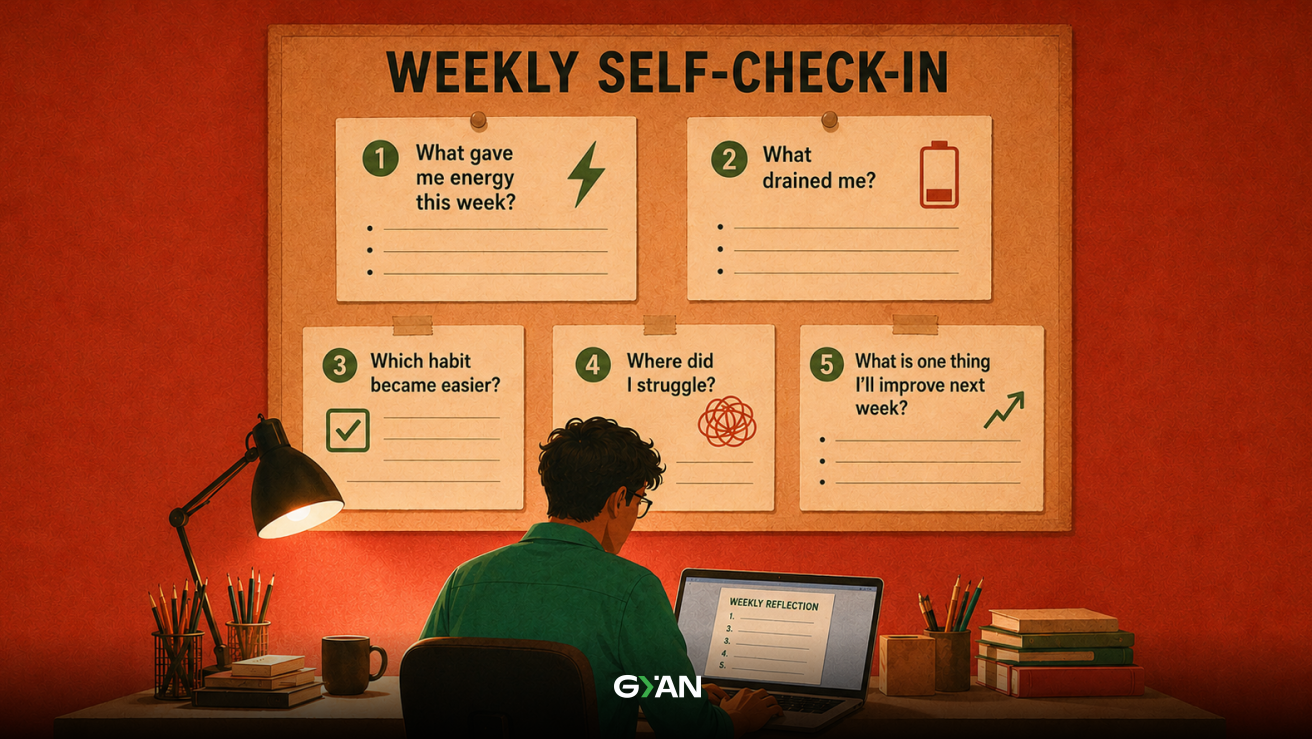
Every Sunday, spend 15 minutes reviewing your week. Ask yourself:
- What gave me energy this week?
- What drained me?
- Which habit became easier?
- Where did I struggle?
- What is one thing I'll improve next week?
These small weekly check-ins stop small setbacks from turning into abandoned goals. If you like structure, the Getting Things Done (GTD) method pairs well with a weekly review.
Missed a Few Days? That's Normal
Life will interrupt your plans: tight work deadlines, a sick child, unplanned travel, unexpected challenges.
But you don't have to wait for another Monday or another New Year to get back on track. Just keep going.
One missed workout doesn't ruin your health. One expensive purchase doesn't destroy your finances. One stressful week doesn't erase your progress. Consistency isn't about being perfect. It's about returning, again and again, whenever life pulls you away.
What Happens After Day 100?
Don't stop there. Retake the self-assessment and compare your scores. Celebrate your progress, then choose one area that still needs attention and keep building from there.
The goal was never just to complete a 100-day challenge. It was to create a life where growth becomes part of your everyday routine.
Resetting your life isn't about becoming someone completely different. It's about becoming more intentional with the life you already have.
Along the way, there will be moments when progress feels slow. Some habits will stick quickly, while others will take longer. And that's perfectly normal.
What matters isn't whether every day goes according to plan. What matters is that you keep showing up.
Because when you consistently improve your finances, health, relationships, mindset, career, purpose and the way you connect with others, you're not just changing your daily routine. You're gradually changing the direction of your life.
And sometimes, that's all a meaningful reset really needs.
Ready to go further? Learn from experts at our upcoming summits.
Explore Summits