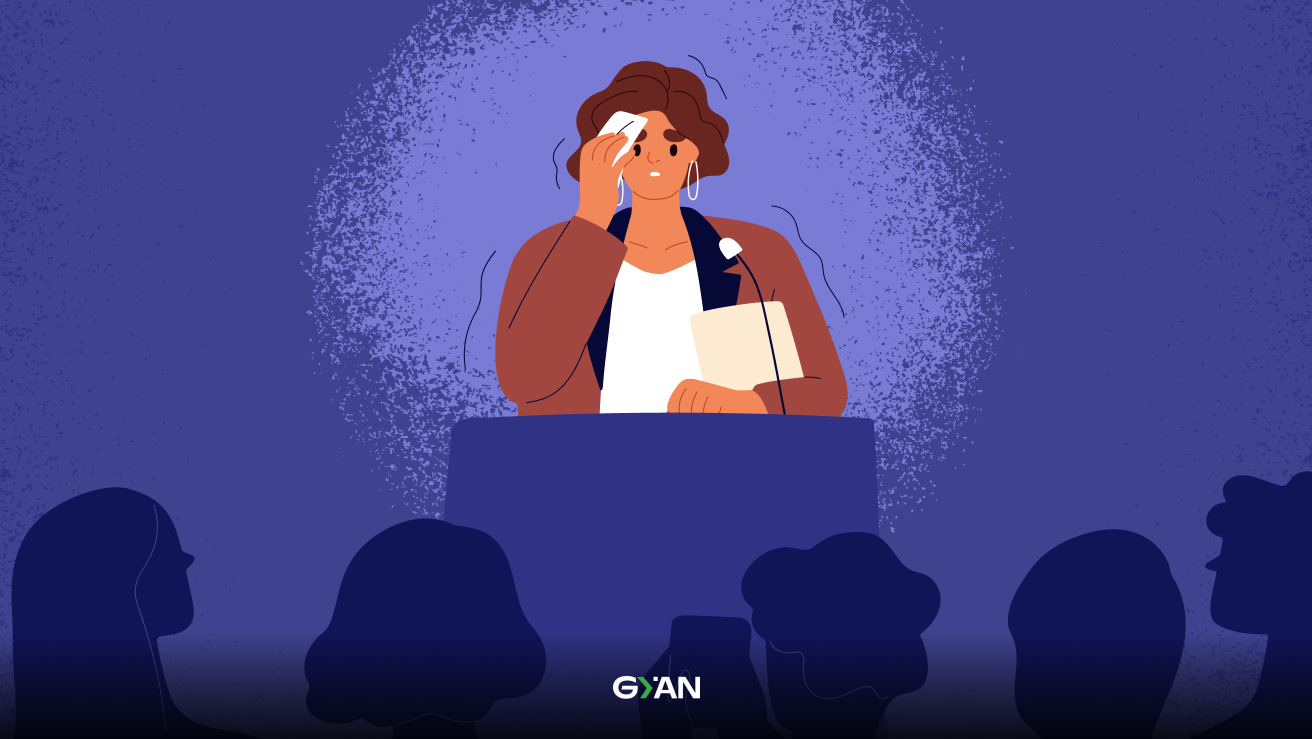
Have you ever been given a topic to speak about in school despite your refusal? Finally, you end up preparing your best only to go up on stage and feel frozen and your words start to fumble. Has that moment turned into one of the most embarrassing moments in your life? If yes, whatever you experienced was stage fright. Stage fright, also referred to as glossophobia, is the intense fear of public speaking, especially before an audience.
According to the National Institute of Mental Health (NIMH), approximately 73 - 75% of people experience glossophobia. This fear ranks higher than the fear of death, according to the research conducted by the National Institute of Statistical Sciences on the brain. Public speaking remains the No.1 social fear worldwide. This prevalence shows that fear is common among various demographics and cultures.
Understand Why Public Speaking Feels Terrifying
The biggest thing that stops people from speaking is the fear of being judged, misunderstood and rejected by people. This “little voice” in the mind is what drives hesitation, avoidance and overthinking.
Public speaking can bring anxiety and fear because human brains are tuned to immediately scan judgment when in a new environment. In the first few seconds of a presentation, the audience is most sceptical. You automatically assume that people start to judge within seconds and that triggers nervousness.
Practical tip: See the audience as subjects who have come to listen and not to judge you.
Realize the Fear Is Psychological
The nervous system does not know that the audience is not a threat. Even though the speaking environment seems to be safe, the body reacts as if it’s facing danger. Altering your mindset removes self-blame and encourages you to move past your fear.
This mindset hinders you from remembering what you prepared and can leave you feeling unfit to stand on the stage. This psychological brain response to the situation can be overcome through specific therapies.
Practical tip: Take deep breaths and practice positive affirmations such as “I can do this”, “I am not in danger”.
Stop Treating Speaking as a Performance
Public speaking becomes stressful when you treat it like a performance. When you feel you have to impress, entertain or prove something, the pressure peaks.
Reframing the purpose of your speech can put things into perspective. This shift can dramatically reduce anxiety, enabling you to speak naturally.
Practical tip: Reassure yourself that “You are not performing. You are just having a conversation to help people”.
Practice Is Non-Negotiable
Public speaking is a skill just like music or athletics. It improves only through repetition. Early attempts may be awkward or disappointing. That’s normal. Every speaker starts with empty rooms and rejection.
The more you practice speaking, the more you become confident in your speech. Just like the popular phrase “Practice makes perfect”, through consistent practice, you will be able to speak without hesitation or fear.
Practical tip: Practice your presentation in front of people whom you are comfortable with and ask for feedback.
Get the Audience Present First
When people enter a room or a Zoom call, they may not be fully present. They may be distracted, checking phones or mentally resentful about giving time to hear from you.
The first thing you need to do is to bring them into the moment. This means giving them value and making them feel connected.
Practical tip: Acknowledge the audience, thank them for being there and make them feel seen and respected.
Start by Asking Questions
Instead of starting with a monologue, start with a question. When you ask the audience something, the pressure shifts off you and onto the interaction. It turns the session into a conversation immediately.
Questions engage the audience and help them think. It automatically calms the speaker because now participation is shared. Once the audience is engaged, nodding, responding and listening, confidence grows because a connection soon establishes.
Practical tip: Ask the audience a simple question that is relevant to the topic that you are going to address.
Tell Them What They’ll Get
At some point early on, a part of the audience wonders, “Why should I listen to you?” When this question is answered, it allows them to give space for you to present your ideas. When you briefly share why you’re here, what drives you and your relevant experience, you’re earning the right to guide the conversation.
Outline the agenda simply and clearly. This reassures the audience that their time is respected and creates psychological safety.
Practical tip: Clearly let the audience know the purpose of your presentation and what benefit they get in return for listening to you.
Speaking Fuels Personal Development
Speaking in front of people builds confidence, self-worth and clarity faster than almost any other skill. Over time, the fear fades and is replaced by fulfillment.
As a part of personal growth, public speaking enhances academic performance, improves listening abilities and fosters networking.
Practical tip: Start your public speaking journey by choosing a topic that is well-known to you and that comes naturally to you.
Broadcast One-to-Many
One-on-one conversations feel safe because the spotlight is small. But confidence in public speaking is built when you slowly expand that spotlight.
Today, broadcasting doesn’t require a physical stage or a crowd staring back at you. The stage is already in your pocket. YouTube, Zoom, video calls and digital platforms let you speak to many people without the immediate pressure of a live audience.
Practical tip: Use these platforms as practice spaces. Speak not to perform, but to become comfortable with your own voice.
Conclusion
Public speaking can feel daunting, but it is not a talent you are born with or without. It is a skill that improves with understanding and practice. Fear does not disappear overnight, but it reduces every time you choose to speak despite it. When you stop trying to impress and start trying to connect, the pressure stops. When you practice consistently, confidence builds naturally.
Focus on helping the audience, not proving yourself. Over time, the stage stops feeling like a threat and starts feeling like an opportunity. The goal is to speak even when fear is present, until fear no longer has power to control you.
